Why Freehold B1 Industrial Projects Keep Selling Out in Singapore


Another freehold B1 industrial project has disappeared almost as quickly as it arrived.
Generations @ Tannery officially launched on 17 July 2026. By 4pm that same day, all 54 production units and five industrial canteen units had been taken up.
The entire development was sold out.
This would be impressive for any property launch. It becomes even more interesting when you consider the pricing. These were not low-quantum industrial units being offered below S$1 million. Entry prices were around S$2.5 million, with psf pricing comfortably within the higher end of Singapore’s strata industrial market.
Yet buyers still rushed in.
Some were trying to secure more than one unit. Others who wanted only a single unit were reportedly left empty-handed.
And this was not an isolated event.
CT Gold Had Already Shown Us What Was Coming
CT Gold @ MacPherson had set the tone earlier.
When sales opened, 157 cheques reportedly chased just 66 units. Many buyers were applying for multiple units, while one buyer reportedly purchased ten.
“One buyer reportedly bought 10 units. That tells us more than a spreadsheet ever could.”
It tells us that the demand was not coming only from individual business owners searching for their next premises.
It was also coming from investors who understood that a small number of freehold industrial units was about to enter the market, and that once those units were sold, there might not be another comparable opportunity for some time.
CT Gold was massively oversubscribed.
Generations @ Tannery has now sold out on its public launch day.
Two projects do not define an entire market. But when two similar projects produce almost identical buyer behaviour, it becomes difficult to dismiss the pattern.
The market is telling us something.

Buyers Are Not Simply Paying for Floor Area
At first glance, the pricing can look difficult to understand.
Why would buyers pay S$1,600, S$1,700 or even more per square foot for industrial property when older leasehold factories can sometimes be purchased at a fraction of that price?
The answer is that these buyers are not simply paying for floor area.
They are paying for a particular combination of qualities that is extremely difficult to recreate:
Freehold tenure
B1 industrial zoning
A modern, brand-new building
A central or city-fringe location
Practical industrial specifications
A limited number of strata units
Remove any one of these qualities and the product becomes easier to find.
Finding all of them together is much harder.
A buyer looking only at psf may conclude that the property is expensive. A buyer looking at replaceability may reach a very different conclusion.
That distinction matters.
The most valuable industrial property is not necessarily the one with the lowest psf today. It may be the one that future buyers and businesses struggle to replace.
Freehold Industrial Supply Cannot Simply Be Manufactured
Singapore can continue releasing industrial land.
New factories, warehouses and business spaces will continue to be built. However, most newly released government industrial land comes with limited leasehold tenure, commonly around 20 to 30 years.
There is nothing inherently wrong with leasehold industrial property. A well-priced leasehold unit with strong specifications and a healthy rental yield can still be an excellent investment.
But the government cannot release a new freehold industrial site through the Industrial Government Land Sales programme.
New freehold strata industrial supply generally has to come from the redevelopment of land that is already freehold.
That makes it a finite pool.
A freehold industrial building can be demolished and replaced, but the underlying amount of freehold industrial land does not suddenly increase.
This is why the scarcity is structural rather than temporary.
Residential buyers often talk about future land supply. Industrial investors need to think about something slightly different: which categories of land can no longer be meaningfully replenished?
Freehold industrial land is one of them.
I previously explored this wider supply issue in Singapore’s Government Role in Attracting Industrial Investment, where I discussed how shorter government land tenures are making existing freehold industrial assets increasingly distinctive.
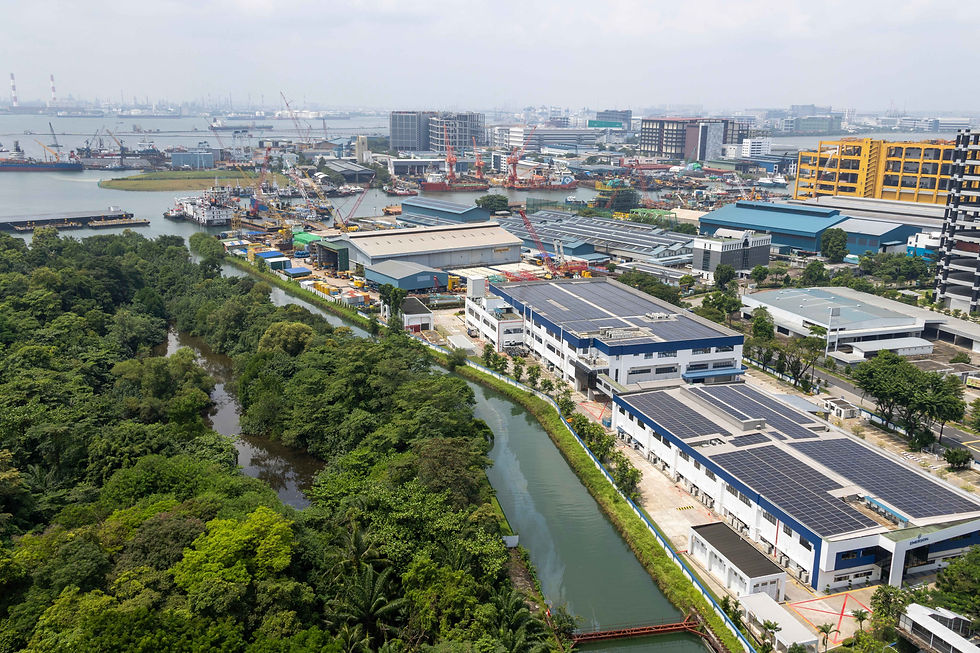
Central Industrial Locations Are More Valuable Than They Look
The location is another important part of the story.
CT Gold and Generations @ Tannery are both within the wider MacPherson, Tannery and city-fringe industrial belt.
These areas are close enough to the city to be convenient, while remaining established industrial locations.
That combination is increasingly useful.
Modern B1 occupiers are not limited to traditional manufacturing businesses. The potential occupier pool can include technology companies, e-commerce businesses, creative studios, laboratories, precision engineering firms, media companies, showrooms and research-related businesses, subject to the relevant planning and usage approvals.
Many of these companies care deeply about accessibility.
They need to recruit staff. They receive clients. Their founders may travel between the factory, office and city centre. Their employees may rely on public transport. Deliveries still matter, but so does the daily experience of the people working inside the building.
This is why central industrial property should not be analysed in the same way as a remote warehouse.
For a city-fringe B1 building, accessibility can directly affect the depth of the tenant pool.
A business might tolerate higher rent if the location helps it recruit more easily, reduces travelling time and presents a better image to customers.
What looks like a location premium to an investor may look like an operational saving to the occupier.
Why Are Buyers Purchasing Multiple Units?
The multi-unit purchases are perhaps the most revealing part of these launches.
A buyer purchasing five or ten units is making a very different decision from someone buying a single factory for personal use.
That buyer may be thinking about long-term rental income, combining units, dividing risk across several tenancies, accommodating future business expansion or eventually selling the units individually.
There is also an allocation issue.
When a development contains only 50 or 60 units, a handful of bulk purchasers can absorb a surprisingly large proportion of the project.
One buyer purchasing ten units at CT Gold effectively acquired around 15% of the entire development.
That changes the experience for everyone else.
A project can appear to have sufficient inventory when preview begins, but much of that inventory can disappear through a relatively small number of transactions.
This is one reason single-unit buyers were left empty-handed. They were not competing only against other individuals. They were competing against buyers building small industrial portfolios.
In a scarce market, the number of buyers is only part of the story.
The number of units each buyer wants may matter even more.
High Psfs Do Not Automatically Mean Poor Value
There is a tendency to assume that a high psf must mean an investment is overpriced.
Sometimes it does.
But psf is only one measurement. It does not tell you about tenure, functionality, rental demand, usable area, future supply or the quality of the location.
A cheaper property can become expensive if it is difficult to rent, approaching the end of its lease or becoming operationally obsolete.
A more expensive property can still perform well if it remains useful, scarce and desirable to future occupiers.
This is especially relevant when comparing brand-new industrial developments with older buildings.
Newer projects may provide better lifts, more presentable entrances, attached toilets, improved loading arrangements, more efficient layouts and modern building systems. They may also be subject to newer GFA measurement rules, making simple psf comparisons with older projects less straightforward.
Investors should still scrutinise the entry price and expected rental yield carefully. But the lowest psf should never be confused with the best investment.
Industrial property rewards usefulness.
That is why I previously argued that some of the most unglamorous buildings can become excellent investments in The Strange Reason Some “Boring” Industrial Properties Become Excellent Investments.

Industrial Property Is Connected to the Real Economy
There is another reason industrial property continues to deserve serious attention.
Industrial buildings are not primarily dependent on lifestyle trends.
They support the physical economy.
Goods still need to be stored. Products need to be assembled. Food needs to be processed. Technology companies need laboratories and production space. E-commerce orders need to be fulfilled. Equipment needs to be repaired. Businesses need premises from which they can operate.
The exact industries will change, but the requirement for functional space does not disappear.
Singapore is also continuing to position itself around advanced manufacturing, biomedical sciences, semiconductors, logistics, food production, data infrastructure and technology.
These activities all require real estate.
The factory floor may look less exciting than a luxury condominium showroom, but it is often far more closely connected to how the economy actually functions.
For investors, this can create a useful layer of resilience.
An industrial tenant is not renting a unit simply because it likes the view. The unit forms part of its operations. Moving may require approvals, machinery relocation, renovations, downtime and changes to staffing or logistics.
That operational attachment can create relatively stable occupancies when the building is suitable and the location is right.
I discussed these broader investment fundamentals in Why Industrial Properties Deserve a Place in Your Singapore Real Estate Portfolio.
Not Every Industrial Property Will Be a Good Investment
None of this means investors should buy industrial property blindly.
Industrial real estate is a specialist asset class.
The permitted use matters. The 60:40 industrial-to-ancillary usage requirement matters. Floor loading, ceiling height, loading access, electrical supply, lift capacity and unit configuration all matter.
GST, Buyer’s Stamp Duty, financing, maintenance fees and potential vacancy must also be considered.
A freehold title cannot compensate for a badly shaped unit, unrealistic rental expectations or a building that does not suit its intended occupiers.
Unit selection remains extremely important.
The wider point is not that every industrial property will perform well.
It is that well-selected industrial assets, particularly those that combine scarcity with genuine business utility, have a strong case for remaining attractive over the medium and long term.
Space Nova Is the Next Test
The next freehold B1 project to face the market is Space Nova.
Its public preview begins on 24 July 2026.
Located at 21 New Industrial Road, Space Nova is another boutique freehold B1 development in a central industrial location. It comprises only 47 strata units across seven storeys.

That is even fewer units than CT Gold or Generations @ Tannery.
Its likely entry quantum of around S$2.4 million to S$2.5 million places it within a similar buyer segment. It is likely to attract both owner-occupiers and investors who missed the previous launches, as well as buyers who successfully purchased at CT Gold or Generations and wish to acquire more.
The market has now seen two very clear examples of what happens when a small freehold B1 project opens for sale.
Buyers may enter the Space Nova preview with a much greater sense of urgency.
Would a complete first-day sell-out surprise me?
Honestly, no.
With only 47 units available, it would take only a modest group of determined buyers, particularly a few seeking multiple units, to absorb a large portion of the development.

That does not mean every unit should be purchased at any price.
It means the competition for the better units could be intense, and the available supply may disappear much faster than a conventional property buyer expects.
The Market Is Moving From Yield to Scarcity
For many years, industrial property was discussed mainly in terms of rental yield.
Yield still matters, but it is no longer the entire conversation.
The strongest recent launches suggest that investors are also paying for permanence, location, utility and limited future supply.
CT Gold showed us the level of demand.
Generations @ Tannery confirmed that the demand was not a one-off.
Space Nova will provide the next test.
The most interesting lesson is not simply that these projects are selling quickly.
It is that buyers are willing to commit millions of dollars, purchase multiple units and compete aggressively despite apparently high psf prices.
That tells us they are not viewing these properties as ordinary factory space.
They are viewing them as a scarce form of Singapore real estate.
Yield can be calculated on a spreadsheet.
Replaceability cannot.
And in the long run, the assets that are hardest to replace are often the ones investors eventually wish they had bought earlier.
Frequently Asked Questions
Why are freehold B1 industrial properties so rare in Singapore?
Most new industrial land released by the government comes with limited leasehold tenure. New freehold developments generally need to be created by redeveloping existing freehold industrial land, making the overall supply structurally limited.
Why did Generations @ Tannery sell out so quickly?
The project combined freehold tenure, B1 zoning, modern specifications, city-fringe accessibility and a relatively small unit count. Demand also came from buyers seeking multiple units, which reduced the inventory available to single-unit purchasers.
Is industrial property a good investment in Singapore?
Well-selected industrial properties can provide rental income, portfolio diversification and exposure to Singapore’s manufacturing, logistics and business economy. Investors must still assess usage restrictions, tenure, specifications, tenant demand, financing and entry price carefully.
Is industrial property subject to ABSD?
Industrial property is not subject to Additional Buyer’s Stamp Duty in the way residential property is. Buyers should still account for Buyer’s Stamp Duty, GST where applicable, legal fees and financing costs.
When does the Space Nova preview begin?
The Space Nova preview begins on 24 July 2026. The freehold B1 development at 21 New Industrial Road comprises only 47 strata units.


Comments