The Next Industrial Property Boom May Be Measured in Megawatts, Not Square Feet


Artificial intelligence is often described as though it lives somewhere invisible.
We call it the cloud. We open an app, enter a question and receive an answer within seconds. The entire process feels weightless, almost as though the technology exists outside the physical world.
But the cloud has an address.
It occupies land. It consumes electricity. It produces enormous amounts of heat. It depends on fibre connections, cooling systems, substations, backup generators and highly specialised buildings that must operate every hour of every day.
Behind the most advanced AI model is something surprisingly familiar: industrial real estate.
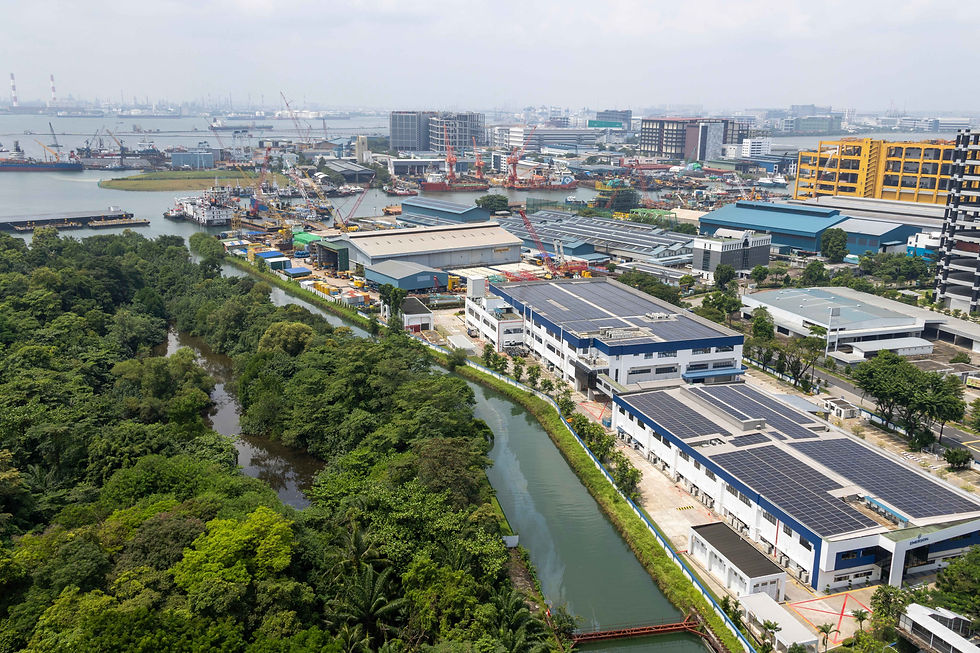
That shift matters for Singapore. We are a global business and digital hub with strong demand for data, but we are also a small island with limited land, limited domestic energy resources and many competing uses for both.
So the real question is not simply whether data centres are a good investment.
The more important question is whether Singapore should keep building them, which facilities deserve our scarce power, and what this tells us about the future value of industrial property more broadly.
The next industrial property boom may not be measured in square feet. It may be measured in megawatts.
AI is a physical property story
Every major technological shift eventually creates demand for physical space.
E-commerce created demand for logistics warehouses and last-mile distribution facilities. Advanced manufacturing created demand for clean rooms, high floor loading, stronger electrical capacity and specialised production space. Food delivery and food security increased the importance of central kitchens, cold-chain logistics and modern food factories.
AI is doing the same thing for data centres.
Training and operating AI models requires vast computing capacity. Those computers must sit somewhere. They require reliable power, constant cooling, security and extremely fast digital connectivity.
This is why a data centre should not be viewed only as a technology investment. Economically and physically, it is a highly specialised form of industrial infrastructure.
The building may look less complicated than an office tower from the outside. Inside, however, almost every part of the asset is designed around one purpose: keeping computing equipment powered, cool, connected and operational without interruption.

Why Singapore remains an attractive data centre location
Singapore has many of the ingredients that digital infrastructure operators and their customers value: political stability, strong regulation, dependable connectivity, access to regional businesses, a sophisticated financial system and a reputation for protecting contracts and critical infrastructure.
The country already has more than 70 cloud, enterprise and co-location data centres, with approximately 1.4 gigawatts of computing capacity. That concentration is not accidental. Singapore acts as a regional headquarters, financial centre and data exchange point for businesses operating across Asia.
Demand is also tight. CBRE reported that Singapore maintained the lowest data centre vacancy rate in the Asia-Pacific region in early 2026, at approximately 2%. Limited available supply gives existing facilities considerable strategic value.
At first glance, this sounds like a perfect property investment story: strong demand, restricted supply, institutional occupiers and high barriers to entry.
But that is only half the story.
Singapore cannot treat power as though it were unlimited
A data centre does not merely need a site. It needs a very large and dependable allocation of electricity.
According to IMDA, data centres account for about 7% of Singapore's total power consumption. Electricity can also represent more than half of the operating expenditure of a typical data centre in Singapore.
This matters because data centres are not the only sectors demanding more power. Semiconductor manufacturing, electrification, transport, advanced industry and the wider economy are all competing for additional capacity. The Energy Market Authority expects Singapore's electricity demand to grow by roughly 2% to 5% annually over the coming years.
Singapore therefore cannot approach data centre growth in the same way as a country with vast land and abundant domestic energy resources.
It is a tension I explored in Singapore Has Too Little Land. Could It Still Build Too Many Homes?: every additional use of land or power in Singapore comes with a real opportunity cost.
The earlier broad pause on new data centre development has already evolved into a more selective growth strategy. Under the Green Data Centre Roadmap, Singapore aims to provide at least 300 megawatts of additional capacity in the near term, with further capacity potentially supported by green energy. A second call for applications launched in December 2025 made at least another 200 megawatts available, subject to demanding efficiency and sustainability requirements.
The direction is clear: Singapore is not saying no to data centres. It is saying that new capacity must earn its place.
Not every data centre creates the same value
This distinction is important.
A facility supporting advanced AI research, financial infrastructure, healthcare systems, cybersecurity or high-value regional business activity may create far greater strategic value than a basic storage operation using the same amount of land and electricity.
Data centres themselves are also highly capital-intensive, but they are not always major employers once completed. That does not make them unimportant. Critical infrastructure often creates value by enabling the rest of the economy rather than by employing thousands of people within the building itself.
Still, Singapore should expect more than rental income and construction spending in return for its scarce resources.
The strongest proposals should help anchor meaningful computing capacity, research, skilled employment, regional headquarters, intellectual property and digital services in Singapore. They should also demonstrate better energy efficiency, practical decarbonisation pathways and an ability to remain technologically relevant.
In other words, the best data centre is not necessarily the largest one.
It is the one that makes the surrounding economy more valuable.
In a land- and power-constrained country, the right question is not how many data centres we can build. It is how much economic and strategic value each megawatt can create.
Power is becoming a new form of property scarcity
Traditional property investors are used to thinking about scarcity through land, tenure and planning permission.
A freehold site is scarce. A prime location is scarce. A building with rare zoning or redevelopment potential is scarce.
Data centres introduce another form of scarcity: deliverable power.
Two sites of similar size can have completely different values if one can secure sufficient grid capacity, redundant supply and fibre connectivity while the other cannot. The ability to deliver an additional megawatt may matter more than adding another thousand square feet of floor area.
This changes how specialised industrial assets are understood. The land is only one layer of value. The infrastructure attached to it may be even harder to reproduce.
For a data centre, investors should be asking:
How much power is secured today, and how much additional capacity can realistically be delivered?
Is the power supply redundant and resilient enough for critical workloads?
How efficient is the cooling system in Singapore's tropical climate?
How close is the facility to major fibre routes and network exchange points?
Can the building support newer, denser and hotter generations of computing equipment?
These are property questions, even if they do not sound like the questions asked at a condominium launch.
Scarcity helps. Usefulness is what converts scarcity into value.
The same lesson applies far beyond data centres
The most useful insight for ordinary commercial and industrial property investors is not that everyone should rush out and buy a data centre. Most individual investors will never own one directly.
The larger lesson is that industrial property is increasingly valued by what the building allows its occupier to do.
In a previous article, The Strange Reason Some "Boring" Industrial Properties Become Excellent Investments, I argued that an industrial operator is not buying a view. The operator is buying productivity.
Data centres take that principle to its logical extreme.
A plain-looking building can be enormously valuable if it has the infrastructure required by a modern business. Conversely, an attractive building can become obsolete if its power, access, loading, cooling, floor loading or layout cannot support future occupiers.
Across the wider industrial market, I believe investors will place increasing value on:
electrical capacity and the ability to support automation, robotics and advanced equipment;
strong floor loading and clear ceiling heights;
ramp-up access, loading efficiency and heavy-vehicle circulation;
cold rooms, clean rooms, ventilation and specialised production infrastructure;
flexible layouts that can adapt to different business uses;
locations that remain accessible to labour, suppliers, ports and customers.
This is why comparing industrial units only by price per square foot can be misleading. The cheaper unit may be poor value if the next generation of tenants cannot operate effectively inside it. I go into this in more depth in Why the Warehouse Floor May Become the Most Important Part of Industrial Property in Singapore.

The most valuable industrial property of the future may not be the building with the most space. It may be the building with the infrastructure that allows the future to operate.
Scarcity does not remove investment risk
Data centres sound compelling because demand is growing and vacancy is low. But rapid sector growth does not guarantee attractive returns for every investor.
The risks are materially different from those of an ordinary warehouse.

Technology can move faster than the building
Computing equipment evolves quickly. New AI hardware can require more power, denser racks and different cooling systems. A facility that was considered modern several years ago may require substantial capital expenditure to remain competitive.
The tenant may be strong, but concentration can be severe
Many data centres depend heavily on one major tenant or a small group of customers. A long lease is valuable only if the tenant remains financially strong and the facility continues to suit its needs.
Rental income may not be as passive as it appears
Investors must understand who pays for power, maintenance, equipment replacement and future upgrades. A seemingly attractive yield can look very different once recurring capital expenditure is properly included.
Government restrictions create scarcity, but also uncertainty
Singapore's controlled supply is supportive of existing assets. It can also make expansion dependent on future policy, energy availability and environmental requirements. The same regulation that protects scarcity can limit an owner's ability to grow.
This is why data centre investing should not be reduced to a simple AI growth story. Investors are not only buying rising digital demand. They are buying a specific building, a specific power allocation, a specific lease and a continuing obligation to keep the asset relevant.
Could Singapore and Johor become one digital infrastructure ecosystem?
Singapore's constraints may also reshape the regional property map.
Markets with more available land and power, particularly Malaysia, are attracting a growing share of Asia-Pacific data centre investment. That does not necessarily mean Singapore loses.
A more likely outcome is a complementary ecosystem. Large, power-intensive campuses can expand in Johor, while Singapore continues to anchor regional headquarters, capital, connectivity, regulated workloads, high-value computing and business decision-making.
Put simply: Singapore could remain the command centre while Johor becomes part of the engine room.
This is not guaranteed. Cross-border infrastructure, energy security, connectivity and regulation will determine how successfully the two markets complement each other. But it is a more useful way to think about the relationship than assuming every new facility built in Johor represents a facility lost by Singapore.
Five questions investors should ask before treating a data centre like ordinary real estate
If you want a broader due-diligence checklist for commercial and industrial property generally, I have laid one out in How to Evaluate a Commercial or Industrial Property Investment in Singapore: A Five-Point Framework. For data centres specifically, five questions matter most.
Is the power genuinely secured?
A site with plans for future capacity is not the same as an asset with confirmed, deliverable and resilient power.
Who carries the cost of technological upgrades?
The lease should make clear which capital expenses sit with the landlord, operator and tenant, especially as AI hardware becomes more demanding.
How concentrated is the income?
A famous tenant can strengthen the covenant, but a single-tenant asset also creates an all-or-nothing renewal risk.
How efficient is the facility?
In Singapore, cooling and electricity costs are fundamental to competitiveness. An inefficient data centre can become commercially unattractive even while overall demand remains strong.
What remains valuable if the current use changes?
Investors should understand whether the site, building and infrastructure have residual value beyond the current tenant and computing configuration.

My view: Singapore should build more data centres, but not indiscriminately
Singapore needs data centres if it wants to remain a serious financial, business, manufacturing and technology hub. AI ambitions without computing infrastructure would be little more than ambition on paper.
But unlimited expansion would also be difficult to justify in a country where every hectare and every megawatt has an opportunity cost.
The sensible position lies between those extremes.
Singapore should continue adding data centre capacity, but it should favour facilities that are highly efficient, strategically important and connected to wider economic value. The country should not compete with larger neighbours simply by trying to host the greatest number of servers.
It should compete by hosting the most valuable computing activity.
For property investors, the broader conclusion is equally important.
The future value of industrial real estate will increasingly depend on infrastructure, not appearance. Buildings with the right power, access, specifications and adaptability will remain useful as the economy changes. Buildings that cannot support modern occupiers may struggle, even in a land-scarce market.
We have spent decades measuring property in square feet.
The AI economy is reminding us that the more important measurement may sometimes be what those square feet are capable of supporting.
Frequently Asked Questions
Are data centres considered industrial property?
Data centres are specialised digital infrastructure, but their physical and economic characteristics are closely related to industrial real estate. They require suitable land, substantial power, cooling, security, fibre connectivity and purpose-built operational systems.
Is Singapore still allowing new data centres?
Yes. Singapore has moved from a broad pause on new development to a selective growth strategy. Its Green Data Centre Roadmap targets at least 300 MW of additional near-term capacity, while a second call for applications launched in December 2025 made at least another 200 MW available, subject to efficiency and sustainability requirements.
Why do data centres consume so much electricity?
Servers operate continuously and generate substantial heat. Electricity is required both to run the computing equipment and to power cooling, ventilation, security and backup systems. AI workloads can be especially power-intensive because they use high-density computing hardware.
Are data centre investments low-risk because tenants are large technology companies?
Not automatically. Strong tenants and long leases can improve income security, but investors still face tenant concentration, technological obsolescence, power cost, capital expenditure and renewal risk.
What does the data centre boom mean for ordinary industrial property investors?
It reinforces a broader trend: industrial buildings will increasingly be valued by their operational capabilities. Power capacity, access, loading, cooling, floor loading, ceiling height and adaptability can matter more than appearance or a low headline price per square foot. I cover where the broader market is heading in Singapore Commercial & Industrial Property Trends in 2026.
Speak to Marc
Understanding where industry is heading helps investors identify which commercial and industrial buildings are likely to remain useful in the years ahead.
For investors reviewing Singapore commercial or industrial property, the key is not simply to buy an asset labelled scarce. It is to identify where scarcity, tenure, infrastructure, specifications, location and genuine occupier demand come together.
If you would like to talk through where Singapore's commercial and industrial property market is heading, or discuss a specific opportunity, feel free to reach me on WhatsApp or by email. You are also welcome to browse my current industrial and commercial listings.
Sources
This article draws on publicly available information from IMDA's Green Data Centre Roadmap, the IMDA-EDB second Data Centre Call for Application, Singapore EDB, CBRE's Asia Pacific Data Centre Trends & Opportunities report and EMA's Electricity Demand and Supply Outlook. It was inspired by a Money FM 89.3 interview with Keith Ong, Co-Founder and Group CEO of RealVantage, on how data centres are changing the definition of real estate investment. This piece reflects an independent Singapore-focused property perspective and is not a transcript or endorsement of any investment offering.
Disclaimer
This article is intended as general market commentary and should not be treated as financial, legal, tax or investment advice. Data centre investments can involve specialised operational, technological and regulatory risks. Investors should conduct their own due diligence and obtain professional advice before making any investment decision.


du doan xsmb mình thấy mọi người bàn tán hoài nên cũng ghé thử cho biết. Mình kiểu người lướt nhanh thôi chứ không rành soi cầu, nhưng vào trang thấy họ làm theo bài theo ngày khá dễ hiểu. Ngay phần “Soi cầu MB ngày 16 8 2026” đặt rõ ràng nên không bị nhầm đang xem ngày nào, kéo xuống là có đoạn dự đoán cho đúng 16 8 2026 luôn. Chữ không dồn một cục, chia thành mấy khối ngắn có tiêu đề nổi bật nên đọc lướt cũng bắt nhịp được. Mình cũng thích cái menu đầu mục để phía trên, bấm qua lại giữa các phần không phải tìm lâu, nhất là mấy heading theo…
Mình chơi xổ số kiểu cho vui là chính, coi kết quả như một thói quen giải trí chứ không đặt nặng chuyện đổi đời. Trước đây nghe người ta bàn về “cầu” với “dàn” mình cũng nghi ngờ lắm, nhưng lâu lâu theo dõi lại thấy có vài chỗ trùng hợp nên cũng tò mò ghi lại. Có lúc mình đọc mấy bài như https://soicauxsmb.io/nuoi-lo-bach-thu-khung-2-ngay.html rồi note nhanh vài ý, sau đó đem so với kết quả thật để tự kiểm tra xem mình có bị cuốn theo cảm giác không. Trúng được chút thì vui, nhưng sai thì cũng nhiều nên mình luôn nhắc bản thân đừng tin tuyệt đối. Nói chung dự đoán chỉ để có chuyện…