What Is a Food Factory — and Why Does Your F&B Business Need One?


Ever wondered how your favourite restaurant chain serves the exact same dish across 10 outlets — with the same flavour, the same portion, the same texture — every single time? The answer is almost certainly a food factory.
A food factory is a purpose-built production facility specifically designed for the preparation, processing, manufacturing, packaging, and storage of food at commercial scale. Unlike a typical restaurant kitchen, a food factory is built from the ground up for volume, efficiency, hygiene, and regulatory compliance — giving food businesses the infrastructure they need to grow without compromise.
In Singapore, food factories are a critical backbone of the F&B ecosystem. From cloud kitchen operators and central kitchen brands to food manufacturers and artisanal producers, a growing number of businesses are discovering that a dedicated food factory space is not just a nice-to-have — it is an operational necessity.
What Happens Inside a Food Factory?
A food factory is far more than just a large kitchen. Depending on the nature of the business, a food factory can house:
Central kitchens for restaurant chains, hotels, and caterers — producing consistent, portioned meals for distribution to multiple outlets
Food manufacturing lines for sauces, condiments, ready meals, frozen food, and packaged products
Bakery and confectionery production — centralised baking facilities that feed retail and wholesale channels
Beverage processing — bottling, blending, and cold brew production at scale
Cold chain storage — chiller and freezer facilities for meats, seafood, dairy, and perishables
Cloud and virtual kitchens — delivery-first operations serving multiple food brands from a single production space
Food innovation and R&D facilities — test kitchens for product development and food-tech research
Packaging and labelling centres — preparing products for retail, wholesale, or e-commerce fulfilment
Why Is a Food Factory So Important for F&B Businesses?
1. Consistency at Scale
Centralising production, standardising recipes and processes, and enabling batch manufacturing ensures every dish, every product, and every batch meets the same standard — regardless of how many orders come in. This consistency protects your brand reputation and builds consumer trust.
2. Cost Efficiency
A centralised food factory lets businesses consolidate production, purchase ingredients in bulk, share equipment, and reduce per-unit production costs significantly — savings that far outweigh the cost of operating the facility as the brand scales up.
3. Regulatory Compliance Built In
Food businesses in Singapore are required to comply with regulations set by the Singapore Food Agency (SFA). Purpose-built food factories come pre-configured with SFA-compliant infrastructure — including approved drainage, exhaust systems, food-safe flooring, and grease separation systems — saving businesses significant time and cost compared to retrofitting a standard commercial space.
4. Scalability and Flexibility
Modern food factories offer flexible unit sizes — from compact starter units to large-scale deluxe production spaces — allowing businesses to right-size their space from day one and upgrade as needed, without the disruption of relocating the entire operation.
5. Enabling New Business Models
Cloud kitchens, meal kit businesses, direct-to-consumer food brands, and wholesale food suppliers all depend on food factory infrastructure to operate efficiently and at scale. Without a food factory, these business models simply are not commercially viable.
Why Singapore Is One of the Best Places in Asia for Food Factory Businesses
Singapore has made food manufacturing a strategic national priority. The Singapore Food Agency's '30 by 30' goal — producing 30% of the nation's nutritional needs locally by 2030 — has driven substantial government investment in food production infrastructure. The food manufacturing sector already employs over 50,000 people and generates more than S$10.7 billion in revenue, with close to 60% exported globally. Singapore's reputation for food safety, quality standards, and logistics connectivity makes it an exceptional base for food businesses looking to serve regional and global markets.
Gourmet Xchange: Singapore's Largest Purpose-Built Strata Food Hub

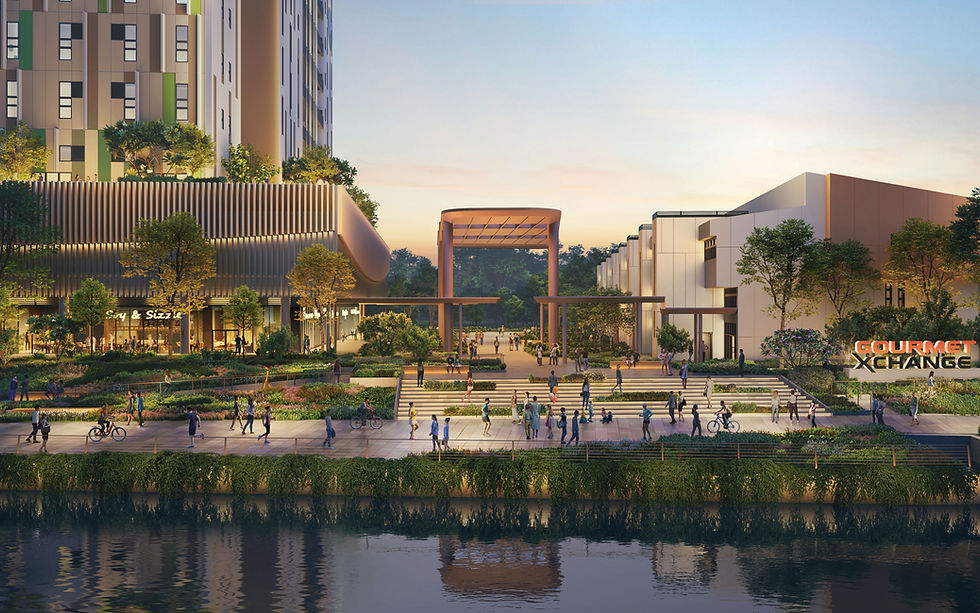
If you are looking for a food factory space in Singapore, Gourmet Xchange at 1 Kallang Way represents the gold standard. Developed by CapitaLand Development (Singapore), it is Singapore's largest purpose-built strata-titled food hub — offering 264 modern production units and 8 heritage terrace units designed specifically for the needs of food businesses.
Prime Central Location: 10 minutes from the CBD, 18 minutes from Changi Airport, with access to four major expressways — PIE, CTE, KPE, and ECP
Purpose-Built Infrastructure: Floor-to-ceiling heights of 7 metres (levels 1–3) and 5.5 metres (levels 4–9), roller shutter access, dedicated loading bays, centralised grease separation, kitchen exhaust duct systems, and high-power electrical supply (up to 400A, 3 phase for restaurant units)
Flexible Unit Options: B2 Standard Units (295–393 sqm), B2 Deluxe Units (570–758 sqm), B1 Heritage Terrace Units (420–529 sqm), plus F&B, restaurant, food kiosk, and industrial canteen options
Truck-Friendly Access: 40-footer container trucks on levels 1–3 and 24-footer rigid-frame trucks on levels 4–9, plus rooftop heavy vehicle parking with 230 lots
Vibrant Food Ecosystem: Riverfront restaurants, cafes, terraces, food kiosks, central plaza, river promenade, fitness corner, and sky garden
Strata-Titled Ownership: Units are available for individual strata ownership — own your food factory space outright
The Bottom Line
A food factory is not just a production space — it is the foundation of a scalable food business. Gourmet Xchange offers food businesses in Singapore the opportunity to operate from Singapore's finest purpose-built food hub — with the location, infrastructure, and community to support every stage of your food business journey. Contact us to find out more about available units at Gourmet Xchange.


Comments