
Beyond "30 by 30": Singapore's Food Production Reset and What It Means for Food Factories

Updated: Jun 2
In late 2025, the headlines said Singapore had dropped its landmark 30 by 30 food goal. Read quickly, that sounds like a retreat from local food production. Read properly, it is the opposite: a sharper, more commercially grounded commitment to producing food at home, and a clear signal about the infrastructure the next decade of Singapore food production will be built on.
For food operators and property investors, the detail beneath the headline matters far more than the headline itself. Here is what actually changed, why it reaches well beyond the farm, and where modern food factories, Gourmet Xchange among them, fit into the picture.
What actually changed
Singapore introduced the “30 by 30” target in 2019: produce 30% of the nation's nutritional needs locally by 2030, using less than 1% of its land. It was always an ambitious goal for a city-state that imports more than 90% of its food.
On 4 November 2025, Minister for Sustainability and the Environment Grace Fu announced a recalibration. Singapore would drop the single 30%-by-2030 target and replace it with category-specific goals: by 2035, local farms should supply 20% of the nation's fibre (leafy and fruited vegetables, bean sprouts and mushrooms) and 30% of its protein (eggs and seafood).
The reasons were pragmatic. Limited land, high labour and energy costs, and a string of farm closures had made the original goal difficult to reach. In 2024, local production covered only around 8% of fibre and 26% of protein consumed here. The new targets are narrower; but, crucially, they arrive with something the original goal lacked: a concrete plan to make local production commercially viable.
Resilience, not retreat, and why it reaches beyond the farm
The strategic intent has not changed. Singapore remains structurally exposed to supply shocks, from regional export bans to climate-driven shortages, precisely because it imports the overwhelming majority of its food. As the Singapore Food Agency has long argued, a resilient, sustainable food system is national infrastructure, not a niche industry.
And food resilience is not only about growing vegetables. It runs across the entire value chain: processing, manufacturing, central kitchens, cold-chain storage and distribution. Locally grown produce still needs to be washed, packed and processed; a local egg and seafood supply feeds local food manufacturing. Strengthening Singapore's food production means strengthening the facilities where food is made, not just the farms where it is grown.
That is where the policy shift becomes directly relevant to property.
The government's own answer: shared, plug-and-play food facilities
The most overlooked part of the November announcement was how the government intends to lower costs for producers. Alongside the new targets, the authorities said they are studying the feasibility of a multi-tenanted food production facility, offering plug-and-play space, common utilities and shared services, so operators no longer each have to build expensive infrastructure from scratch. The logic, as the SFA's leadership framed it, is simple: when production costs fall, local producers can lower prices and sell more.
In other words, the direction of national policy validates a model the private market is already delivering. Which brings us to one of the clearest current examples of it.
Where Gourmet Xchange fits

Gourmet Xchange delivers this model today. Located at 1 Kallang Way in the city-fringe Central Region, Gourmet Xchange is Singapore's largest strata-titled food factory development: 272 units across The Xchange, a nine-storey production block, and Heritage Terrace, a cluster of retained terraced units for food-related and customer-facing uses.
For operators, the appeal is operational rather than theoretical:
Purpose-built, food-zoned space. Units sit in a Prime Food Zone (B2) and are designed for food production from the outset, with no retrofitting of generic industrial space.
Integrated shared amenities. Common facilities spread costs across tenants: the same cost-spreading logic the government is now studying, available now.
Heavy-vehicle logistics built in. Ramp-up access for 40-footer container trucks to Levels 1 to 3, a 16-metre-wide driveway, dedicated loading and unloading, and common container bays.
A genuinely central location. Roughly ten minutes from the CBD, a short walk to Mattar MRT, and well linked to the PIE, CTE and KPE; shortening delivery routes and widening the labour pool.
Room to grow. Unit sizes run from compact ~3,175 sqft B2 production units to 8,000+ sqft deluxe floors, giving food businesses a path from start-up to scale-up under one roof.
For food manufacturers, central and cloud kitchens, bakeries and FMCG brands, Gourmet Xchange does what the government wants shared facilities to do for farms: it lowers the barrier to running a modern, cost-efficient food operation in Singapore.
The investment case
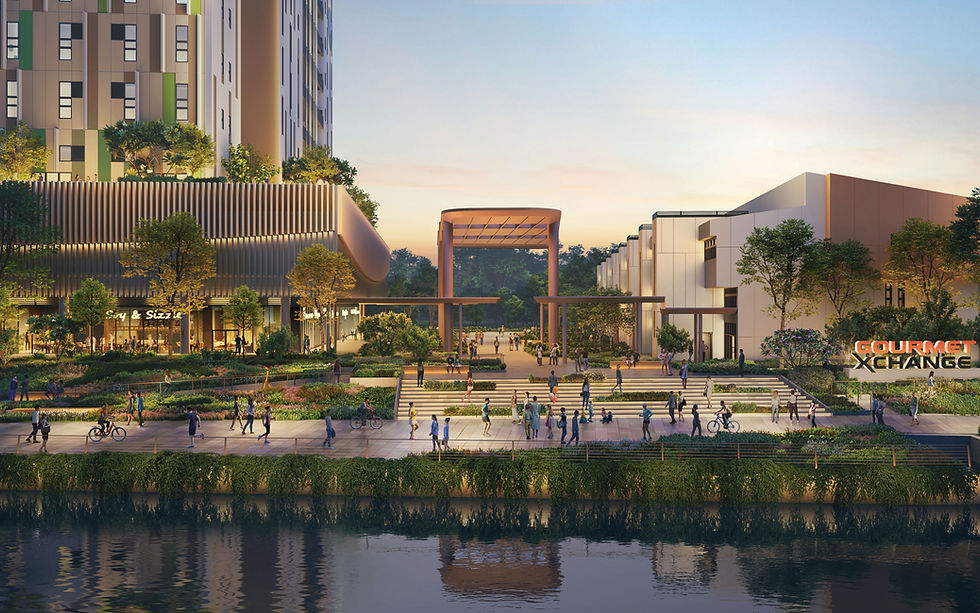
For investors, Gourmet Xchange sits at an unusual intersection: a specialised, sector-resilient asset in a scarce central location, supported by long-term policy tailwinds. A few fundamentals stand out:
Sector resilience. Food is a defensive, demand-stable sector, and national policy is actively working to keep more of the value chain onshore.
Scarcity. Food-zoned industrial space in the Central Region is rare; central strata-titled food factories rarer still.
Industrial asset advantages. Industrial property in Singapore is not subject to Additional Buyer's Stamp Duty (ABSD), which broadens the buyer pool and supports liquidity relative to residential assets.
Tenant depth. A wide spectrum of potential occupiers, from manufacturers to cloud kitchens, supports a scalable, diversified tenant profile.
Timing. With a 33-year leasehold from 2025 and estimated completion in H1 2028, the development is entering the market just as the policy emphasis on cost-efficient local food production sharpens.
None of this is a guarantee of returns, and every buyer's circumstances differ; this is general information, not financial or investment advice. But the structural story is coherent: Singapore is doubling down on making local food production work, the cost of that production increasingly runs through shared, purpose-built facilities, and well-located food factories are positioned to benefit.
The bottom line
Singapore did not abandon local food production in November 2025; it became more realistic about how to achieve it. The headline goal changed; the commitment to food resilience, and the recognition that it depends on cost-efficient production infrastructure, only deepened.
For food businesses weighing where to base their operations, and for investors seeking exposure to a sector the government is actively protecting, that shift is worth paying attention to. Gourmet Xchange is one of the clearest expressions of where this is heading.
Sources: Reuters, Channel NewsAsia, and the Singapore Food Agency. Property details from the Gourmet Xchange project materials; figures and specifications are indicative and subject to change. This article is general information and does not constitute financial, investment or contractual advice.


Comments