Central Kitchens: The Secret Weapon of Singapore's Fastest-Growing Food Brands


A central kitchen — sometimes called a commissary kitchen or production kitchen — is a dedicated, centralised food production facility where a business prepares, cooks, and packages food at scale, before distributing it to retail outlets, restaurants, delivery platforms, or wholesale customers.
Rather than cooking from scratch at every individual outlet, a food brand with a central kitchen can prepare large batches of sauces, proteins, doughs, and ready-to-serve dishes in a single, controlled environment — then distribute finished or semi-finished products across its network. Central kitchens are the backbone of modern food brand scaling strategies in Singapore and across Asia.
Why Do Food Businesses Need a Central Kitchen?
Consistency Across Every Outlet
When each outlet cooks independently, variations in ingredient quantities, cooking times, and techniques are inevitable. A central kitchen eliminates this variability by standardising production — ensuring every customer gets the same experience whether dining at your flagship restaurant or ordering via a delivery app.
Significant Cost Savings
Labour is one of the highest costs in any food business. A central kitchen dramatically reduces the skilled kitchen staff needed at each individual outlet. When bulk prep and cooking is handled centrally, outlet kitchens can operate with smaller, lower-cost teams focused on finishing and service. Purchasing ingredients at bulk quantities at the central level also generates meaningful savings.
Faster Expansion
With a central kitchen supplying multiple outlets simultaneously, expanding your brand footprint becomes far easier. New outlets can be opened with smaller kitchen setups and less complex operational requirements — accelerating your growth timeline and reducing the capital investment needed for each new location.
Better Quality Control and Food Safety
Centralised production allows for rigorous quality control processes, standardised food safety protocols, and efficient recall management. All staff training, hygiene monitoring, and Singapore Food Agency (SFA) regulatory compliance can be managed from a single facility — far easier than managing compliance across multiple sites.
Enabling Delivery and Cloud Kitchen Models
The explosive growth of food delivery platforms has created a new generation of food brands that operate exclusively through delivery — with no dine-in presence at all. These cloud kitchen or virtual kitchen models are entirely dependent on a central production facility. Singapore has seen strong growth in cloud kitchen operations, driven by platforms such as GrabFood and foodpanda and the continued shift toward delivery-first consumption.
What Makes a Great Central Kitchen Facility?
Not all production spaces are created equal. For a central kitchen to operate efficiently, it needs:
High ceiling heights to accommodate commercial kitchen equipment and ventilation systems
Robust power supply — commercial kitchen equipment such as blast chillers, combi ovens, and industrial fryers demand significant electrical capacity
Dedicated kitchen exhaust systems with proper ventilation and grease separation
Efficient loading and unloading infrastructure for ingredient delivery and product distribution
Cold storage and refrigeration capabilities for perishable ingredients and finished products
SFA-compliant construction with food-safe flooring, drainage, and surfaces
Accessible location for both ingredient suppliers and distribution logistics
Modern purpose-built food factories are specifically designed to meet all of these requirements — unlike generic commercial spaces or shophouses, which require expensive retrofitting that may not fully satisfy regulatory requirements.
The Rise of Food Hubs in Singapore
Singapore's government has long recognised the importance of clustering food production businesses in dedicated hubs. The JTC Food Hub model established the concept of purpose-built, government-managed food production clusters at locations such as Senoko and Bedok. However, growth in demand for food production space has created significant opportunities for private-sector food hubs to fill the gap — particularly in the form of strata-titled food factories that businesses can own outright.
Gourmet Xchange: The Ideal Home for Your Central Kitchen in Singapore

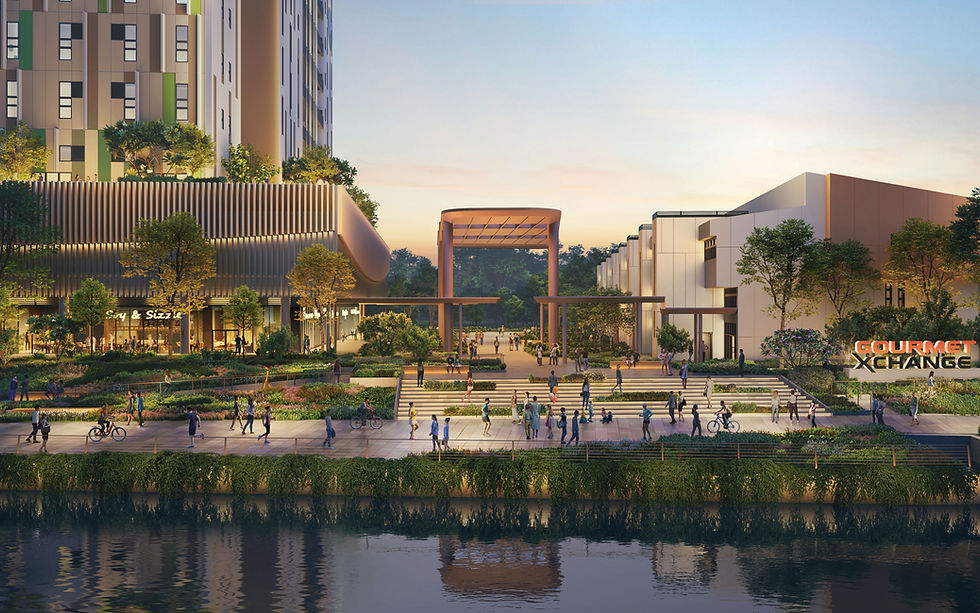
When it comes to finding the ideal central kitchen space in Singapore, Gourmet Xchange at 1 Kallang Way sets the benchmark for what a purpose-built food production facility should look like. Developed by CapitaLand Development (Singapore), it is Singapore's largest strata-titled food hub — designed from the ground up to support exactly the kind of central kitchen operations that today's food businesses need.
Infrastructure Built for Central Kitchen Operations: Production units feature floor-to-ceiling heights of up to 7 metres (levels 1–3), high-power electrical supply (up to 250A 3-phase for large units; 400A for restaurant units), dedicated roller shutter loading bays, centralised grease separation, and kitchen exhaust air duct systems
Range of Unit Sizes for Every Scale: Standard Units (295–393 sqm), Deluxe Units (up to 758 sqm), and Heritage Terrace Units (420–529 sqm)
Exceptional Logistics: Ramp-up truck access up to level 9, 230 rooftop heavy vehicle parking lots, and proximity to all four major expressways (PIE, CTE, KPE, ECP)
A Thriving Food Ecosystem: Surrounded by fellow food producers, suppliers, distributors, and a rich variety of F&B operators along the Kallang waterfront
Own Your Space: As a strata-titled development, Gourmet Xchange gives food businesses the option to purchase their production unit — providing asset ownership, long-term cost certainty, and the security of owning your operational base
Is a Central Kitchen Right for Your Food Business?
If any of the following describe your situation, a central kitchen may be exactly what you need:
You operate or plan to operate more than one F&B outlet and are struggling to maintain consistency across locations
You are growing a food delivery or cloud kitchen business and need dedicated production space
You produce a food product — sauces, frozen meals, baked goods, beverages — that you supply to retailers, restaurants, or wholesale customers
You are a food-tech startup developing a novel food product and need a compliant R&D kitchen
You want to reduce labour costs and improve operational efficiency through centralised production
Gourmet Xchange is now open for enquiries. With units suitable for central kitchens, food manufacturing, cloud kitchens, cold chain operations, and F&B retail, it is the most comprehensive food production hub in Singapore. Contact us today to schedule a viewing and find out which unit is right for your operations.


Comments